İsmetpaşa Mh. Asaf Paşa Cd. No: 78
Merkez/Çanakkale
The agriculture sector is one of the most privileged sectors in Çanakkale in terms of its share in
gross domestic product, its effect on employment and its pioneering vegetable production, along
with its branded products and the added value it creates.
Many of the agricultural product requirements of agro-industry are grown in Çanakkale’s large
expanses of fertile soil, while the city provides important opportunities for agro-industrial
investments.
Land Characteristics
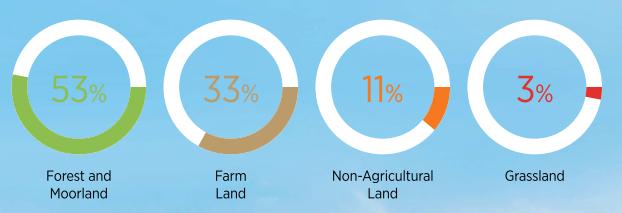
Çanakkale’s 993,318 hectare area is made up of 525,580 hectares of forest and moorland, 331,633
hectares of farm land, 104,440 hectares of non-agricultural land and 31,665 hectares of grassland.
Pioneer in Agricultural Production
Çanakkale has a favorable climate and soil structure for the growing of a wide variety of fruits and
vegetables.
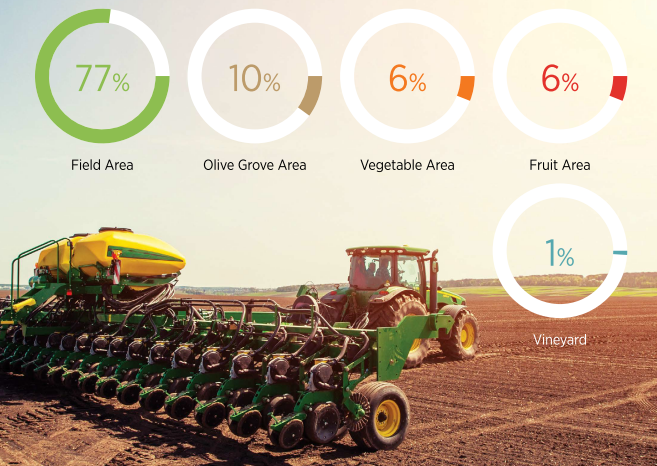
Agricultural area consist of 256,254 hectares of field, 32,214 hectares of olive groves, 20,268
hectares of vegetable production land, 18,155 hectares of fruit production area and 4,743 hectares
of vineyards.
Large Irrigable Agricultural Areas
Irrigation is provided by 8 dams and 47 reservoirs, ensuring the sustainability of agricultural
production in the province.
Some 23% of the total agricultural lands in Çanakkale are irrigated agriculture, compared to 19.5% across Turkey. Some 69% of the irrigable areas in the province are irrigated, compared to 65% across Turkey.
Pressurized irrigation systems are widely used in Çanakkale in agricultural production, especially in vegetable and fruit production.
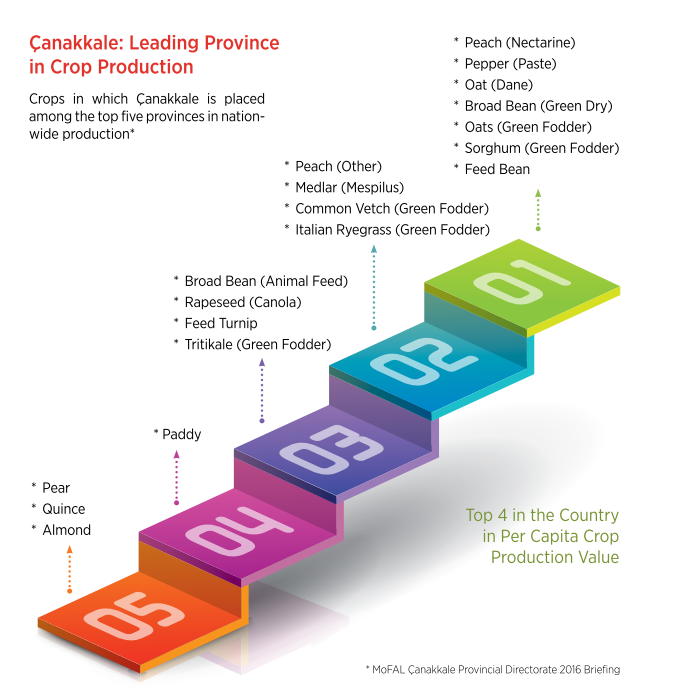
Çanakkale: Leading Province in Crop Production
Wide Variety of Fruit and Vegetable Production
Çanakkale is a province in which a broad range of fruits and vegetables are grown thanks to its
ecological characteristics.
The share of agricultural areas set aside for fruit and vegetable production in the total agricultural
areas in Çanakkale is above the Turkey average.
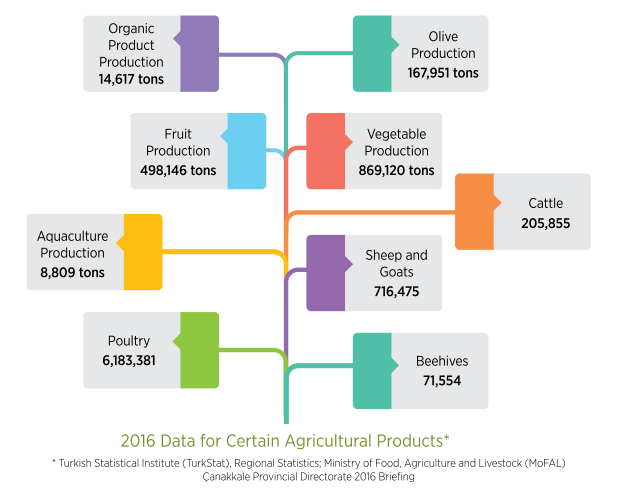
According to the data of 2016, 498,146 tons of fruit were produced in Çanakkale on an area of
551,119 decares.
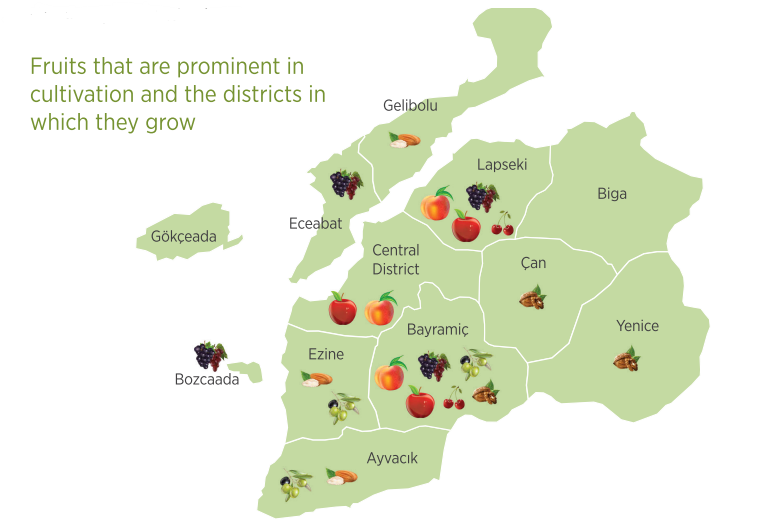
The fruit with the highest level of production is the olive (oil, table), with 167,951 tons, followed by
peach (nectarine, other) with 120,553 tons, and apple with 102,936 tons. Other fruits produced
intensively in the province are grape, cherry, pear, plum and almond.
Quality designations for aroma, taste and flavor of the Bayramiç White Nectarine and Bayramiç
Apple, which have an important place in Çanakkale’s fruit production, have been registered with
a geographical indication.
Wide Variety of Fruit and Vegetable Production
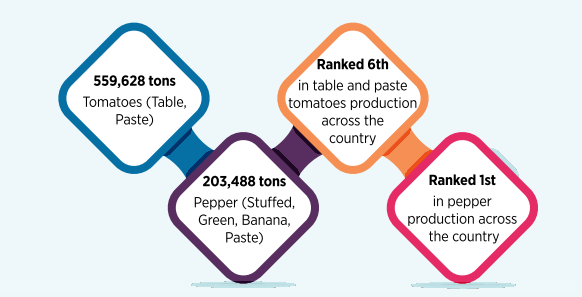
According to 2016 data, 869,120 tons of vegetables were produced in Çanakkale on an area
of 202,676 decares. Tomatoes (table and paste) and peppers (paste, green, banana, stuffed)
have the highest production amounts in vegetable production, with 559,628 tons and 203,488
tons respectively. Other vegetables that are produced intensively are beans, cabbage, eggplant,
cucumber and lettuce.
Çanakkale is the Way to a Healthy Diet
14,617 tons of Organic Crop Production on an area of 41,260 Decares*
Çanakkale offers favorable conditions for organic farming, which is becoming more popular every
day, and is on its way to becoming Turkey’s base for organic farming in the near future.
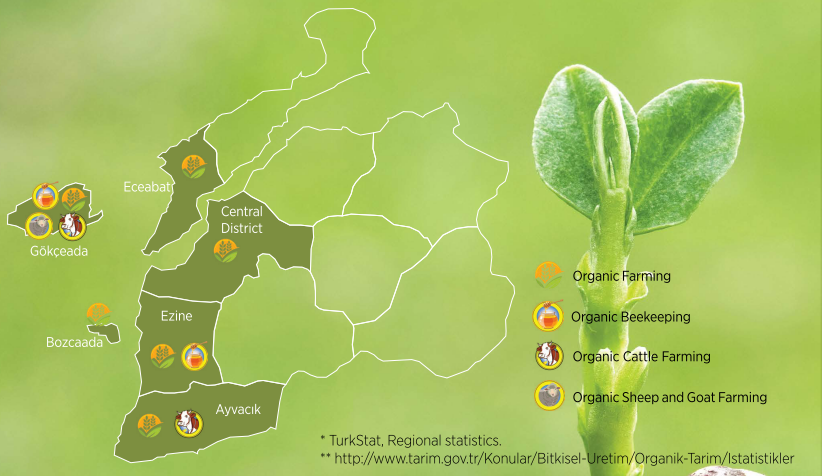
Various products such as olives, alfalfa, corn (silage), grape (table), oat, almond, corn, walnut and
pepper are produced using organic farming methods.**
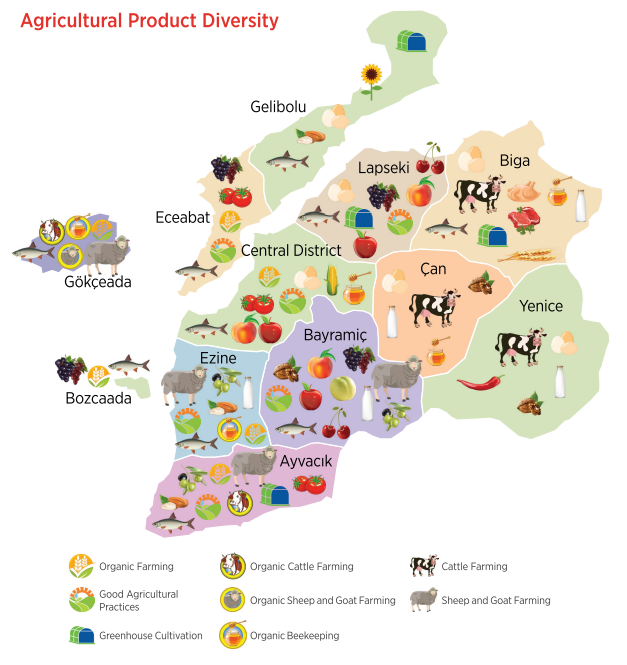
The leading districts in the field of organic crop production in Çanakkale are Gökçeada, Ayvacık,
Ezine, Eceabat, Central District and Bozcaada.
Organic Livestock Production
In addition to organic farming activities, Çanakkale is also known for its organic livestock farming.
Gökçeada is known for its organic cattle, sheep and goat farming, as well as its organic beekeeping
activities; while Ayvacık is noted for its organic cattle farming; and Ezine for its organic beekeeping.
Good Agricultural Practices
Çanakkale is ranked among the top 10 cities in Turkey in terms of good agricultural practices in
production.
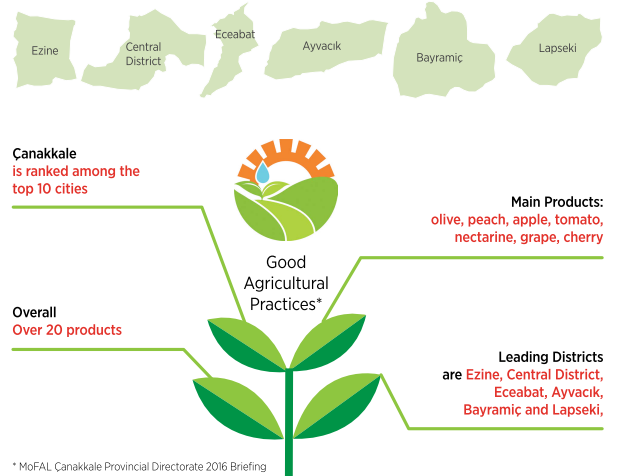
Within the scope of these agricultural practices, more than 20 crops such as olives, peaches,
apples, tomatoes, nectarines, grapes and cherries are grown.
Ezine, Central District, Eceabat, Ayvacık, Bayramiç and Lapseki are the leading districts in good
agricultural practices.
Çanakkale: the Address of Organic Olive Farming
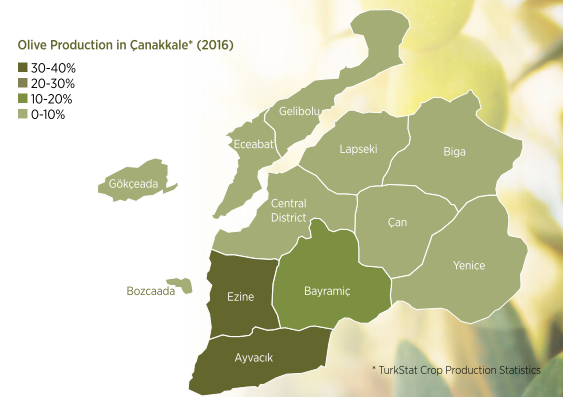
Çanakkale produces predominantly olive oil, 94% of which are produced for olive oil, and 6% as
table olives. According to 2016 data, Çanakkale is ranked 6th in oil olive production and 12th in
table olive production.
Çanakkale is among the provinces with the highest average yield per tree across the country in
both the oil and table olive varieties.
The Ayvacık, Ezine and Bayramiç districts stand out in olive production.
Organic olive farming is carried out in most of the areas in which organic farming activities are
popular in Çanakkale, and the province offers great potential in terms of organic olive and organic
olive oil production.
Ranked First in Oat, Sorghum and Fodder Pea Production
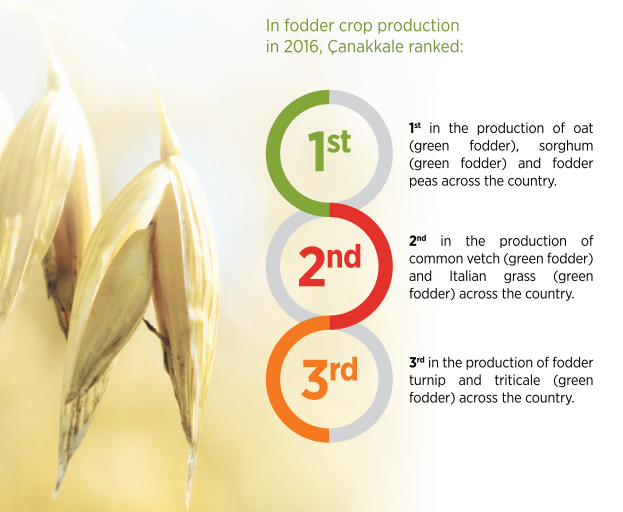
Regarding feedstuff production, which is a significant cost in terms of livestock sector in Çanakkale,
fodder crops such as oats (green fodder), sorghum (green fodder), fodder peas, common vetch
(green fodder), Italian ryegrass (green fodder), fodder turnip and triticale (green fodder) are
grown.
1,768,078 tons of fodder crops were produced in Çanakkale in 2016.
Greenhouse Cultivation
Crops such as cucumber, lettuce, tomato, pepper, green beans, eggplant and strawberry are
produced in Çanakkale in greenhouses.
Ayvacık, Biga, Gelibolu and Lapseki are the leading districts in greenhouse cultivation activities.
The geothermal resources of the province offer opportunities for cost savings in energy in terms
of greenhouse investments.
Cattle Farming in Çanakkale
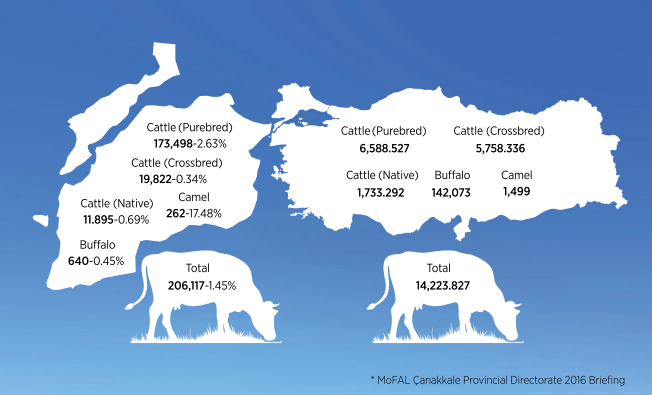
According to 2016 data, Çanakkale has 1.45% of the total number of cattle in Turkey, numbering
205.855*.
Biga, Yenice and Çan are the leading districts for cattle breeding.
Sheep and Goat Farming in Çanakkale
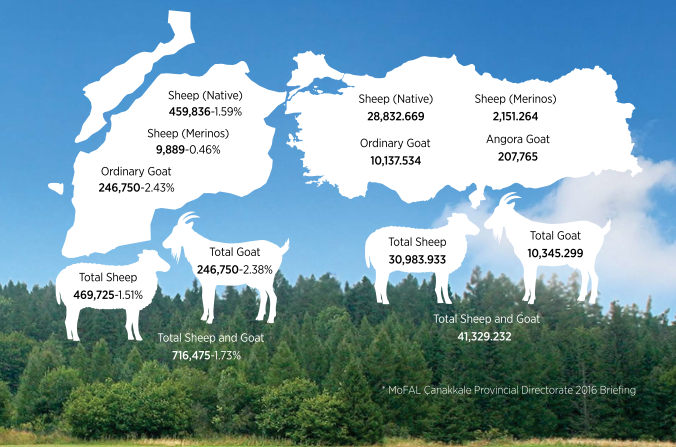
According to 2016 data, Çanakkale has 1.73% of the total number of sheep and goats in Turkey,
numbering 716.475*.
Most of the goats in the province are Turkish Saanen goats, which have a high milk yield, and
Çanakkale is one of the most important centers of goat breeding in Turkey, based on its large
number of Turkish Saanen goats.
The leading districts in sheep and goat breeding are Ayvacık, Gökçeada, Ezine and Bayramiç.
Branded Dairy Products
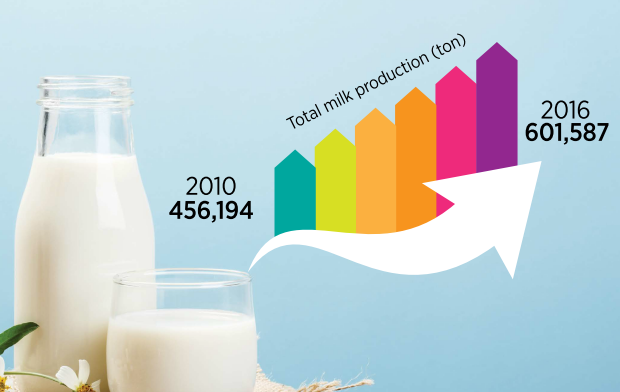
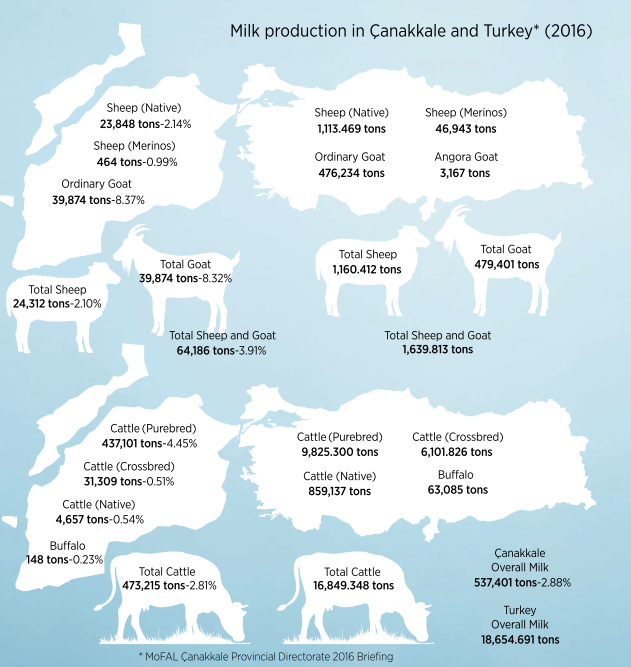
According to 2016 data, Çanakkale has a 2.88% share of cattle milk production and 3.91% share of
sheep and goat milk production in Turkey.
According to 2016 data, Çanakkale is ranked among top 10 cities in goat milk production in Turkey
with 39,874 tons.
Ezine Cheese, a product identified with Çanakkale, is produced by mixing in particular proportions
milk obtained from sheep, goats and cows fed with the natural vegetation and water resources of
the Ezine, Bayramiç and Ayvacık districts, which are located in the northern and western parts of
Mount Ida. These characteristics of Ezine Cheese give it a place on the list of Çanakkale’s products
with a geographical indication.
Biga, Yenice, Çan, Ezine and Bayramiç are the leading districts in milk and dairy production.
Quality Meat Products
Çanakkale produced 7,575 tons of meat in 2016.
Most of the meat in Çanakkale is produced in the district of Biga, and most of the meat produced
is sent to the metropolitan provinces.
Gökçeada, Ezine and Ayvacık are the leading districts in organic animal production.
Poultry Farming in Çanakkale
Broiler poultry farming is very popular in Çanakkale, and the province accounts for 2.68% of total
broiler production across Turkey.
Biga is the leading district in broiler farming, while Biga, Çan, Gelibolu, Lapseki and Yenice are the
most predominant in egg production.
Address of Good Honey
Çanakkale has rich flora suitable for beekeeping activities. Alongside the predominantly produced
blossom honey, pine honey is also produced in the province.
There are indigenous bee species around Mount Ida and Gökçeada, where there is important flora
for apiculture.
According to 2016 data, there are 71,554 beehives in Çanakkale, producing 1,155 tons of honey.
The Biga, Center, Çan and Yenice districts are the leaders in beekeeping activities.
Organic beekeeping activities are carried out in the Gökçeada and Ezine districts.
Aquaculture Production to High Standards
With coasts on the Marmara and Aegean Seas, as well as the Çanakkale Strait, Çanakkale has a
high aquaculture potential.
The Çanakkale Strait allows a large variety of species to survive for aquaculture, and is located on
the migration routes of many species.
Aquacultural products that are exported from Çanakkale include fresh-chilled and frozen fish,
processed seafood (canned), processed bivalve mollusks, marinati shrimp and sand mussels.
Eight of the 96 country-wide EU-certified fishery processing and inspection facilities are located
in Çanakkale, and these facilities export to EU member countries.
The Ever-Growing Agricultural Export Market
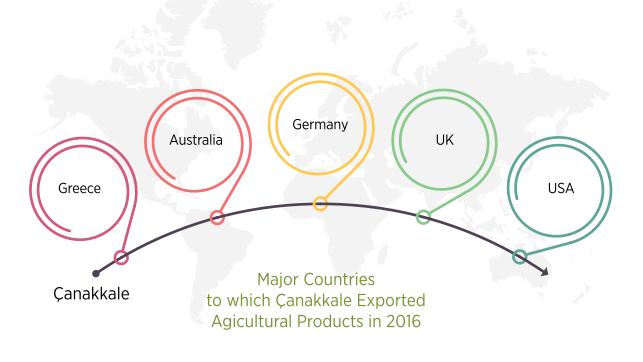
Çanakkale’s agricultural product export value is over USD 33 million, with canned products, frozen
fruits/vegetables, seafood and fresh fruits/vegetables having the largest share in agricultural
exports from the province.
The most important raw material in terms of exported canned products and frozen fruits and
vegetables is the capia pepper.
The products canned for export are produced in facilities in the districts of Biga and Yenice; while
frozen fruits and vegetables are produced in facilities in the districts of Biga, Lapseki, Yenice and
Gelibolu.
High Employment in the Agricultural Sector
Çanakkale is a leading province in Turkey in agricultural production, and is one of the provinces
in which a significant proportion of the working population is employed in the agricultural sector.
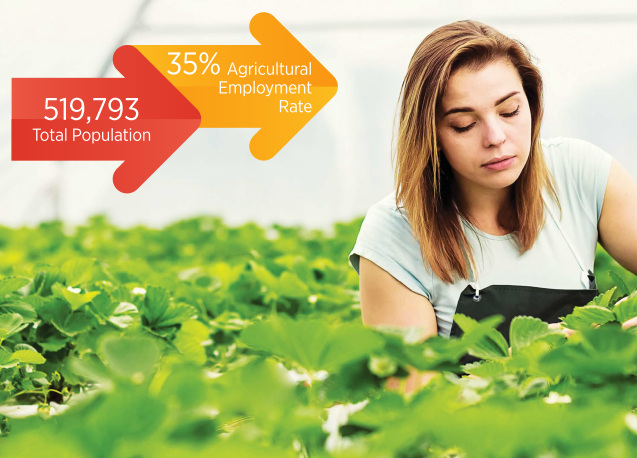
According to 2016 data, the share of agriculture in the total workforce was 20% across Turkey, and
35% in Çanakkale.